
A market is the one place in a city where almost nothing is staged for you. Restaurants hand you a menu written to please, museums hand you a wall text, and the photogenic streets get swept before the cruise crowds arrive. The market opens at six, smells of wet cardboard and parsley, and gets on with the business of feeding people who actually live there. If you have one free morning in an unfamiliar city, spend it here first. Not to buy souvenirs. To read the place.
Start With the Building, Not the Produce
Look up before you look down. A nineteenth-century cast-iron hall with a glass roof, the kind you find in Turin or Budapest, tells you a city that once treated food retail as civic infrastructure, on a par with the railway station. A sprawl of tarpaulins, crates and narrow lanes, as in Palermo's Ballarò, tells you something different: a market that grew wherever the streets allowed it, and that nobody has since found the nerve to move. Both are honest. They simply describe different centuries and different ideas about order.
Then watch the entrances. In nearly every market, the front and the central aisle belong to whatever sells on impulse: fruit stacked into pyramids, flowers, pastries, a man with a griddle. The work of cooking gets pushed to the cold edges and the back doors — bones, offal, sacks of pulses, the fish counter — where the rent is lower and the regulars already know the way. Walk only the middle and you have seen the window display.
Layout Is a Map of How the City Eats
Clusters and fault lines
Markets sort themselves by a logic you can learn in ten minutes. In many Mediterranean cities the fish and meat sit around the perimeter, wrapped about a core of vegetables; elsewhere, prepared food forms a ring around the raw. Find the bar or the café counter. In Italy it is the social centre of the whole building, retired men standing with an espresso, arguing about football, using the market as a living room. Sit there for twenty minutes. You will learn more about the neighbourhood than from most walking tours.
Raw versus cooked
The ratio of ingredients to food you can eat on the spot is a useful gauge. A market heavy on raw produce and thin on prepared food suggests households that still cook, with the time and the kitchens to do it. A market that is mostly hot food eaten standing says the opposite: small flats, long commutes, a culture of eating out. Neither is a decline. But one of them tells you what Sunday looks like in that city.
Seasons You Can Actually Taste
Supermarkets flatten the year. A market shows it to you in volume: whatever is piled highest, cheapest and handled most casually is at its peak. The same fruit, small, wrapped in paper and placed near the till, is at the very start or the ragged end of its season. Learn to read the heap.
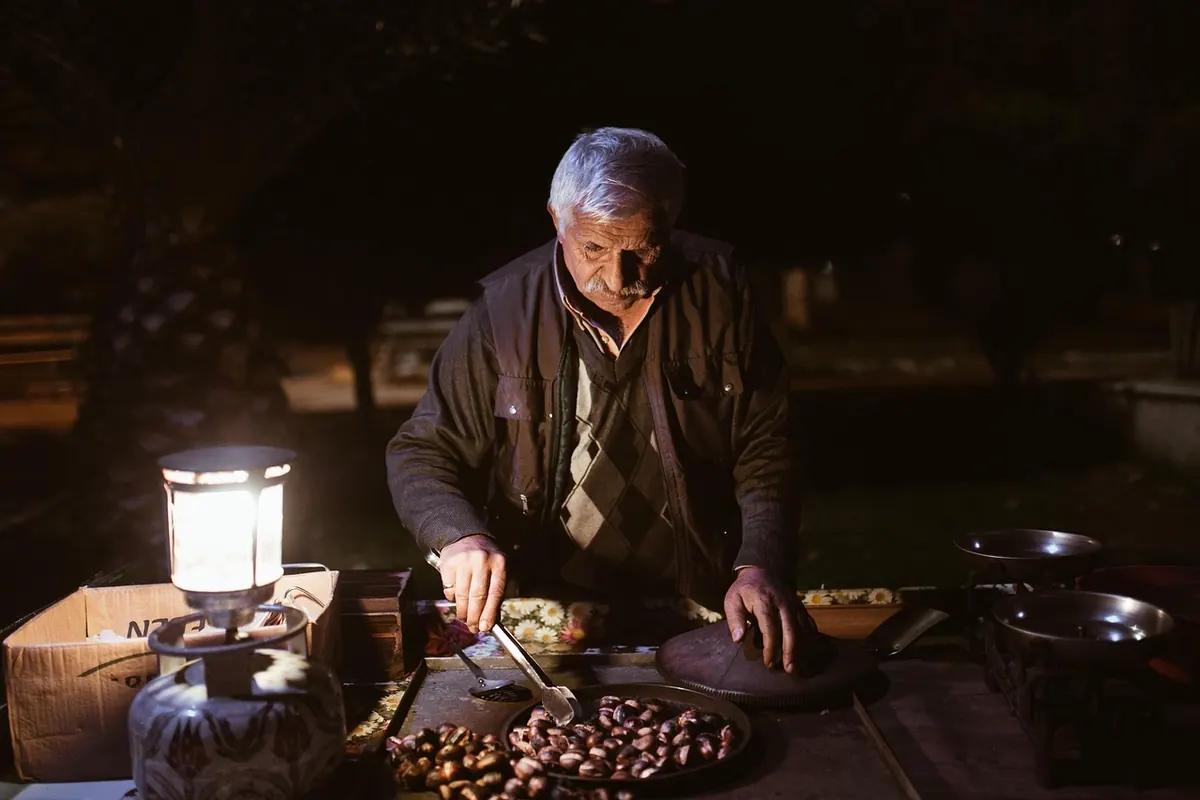
This is the fastest way to know what month you are in, gastronomically. Artichokes in Rome in spring. Tomatoes that smell of tomato in late summer. Chestnuts, squash and olive oil pressing in autumn; citrus in the winter south. Ask a vendor what is good today, and mean it. A good seller will steer you away from the flawless-looking thing and toward the one that eats better and costs less.
The Vendors Are the Index
Learn four phrases before you go: what is this, how do you cook it, which one is better, and thank you. Buy something small first — a handful of olives, a peach — then ask. Vendors are busy, not unfriendly, and a transaction earns you thirty seconds of real conversation.
What to watch for:
- Queues. Where locals wait patiently is where the quality is, whatever the signs claim.
- Hands. A vendor who handles produce gently and tosses the bad ones aside before you ask is telling you everything.
- Generosity. A sprig of parsley dropped into a regular's bag, a taste offered to a child. Small signals of a relationship rather than a transaction.
- Language. Signs in three languages near the entrance usually mean the market has learned to serve visitors. Signs only in dialect usually mean it has not needed to.
- Who is selling. Family stalls that go back generations and newer immigrant-run stalls now sit side by side in most European markets. That geography is the neighbourhood's biography.
Haggling is not universal, and getting this wrong marks you instantly. In much of southern Europe prices are fixed and bargaining over a kilo of tomatoes lands as a mild insult. Watch the person ahead of you in the queue, then copy them.
Notice What Is Missing
Absence is information too. A market with no bread and no cheese probably sits in a city where you buy those at a bakery and a dairy, each with its own shop and its own queue. A market selling tripe, tongue, ears and bones is describing a cuisine built on thrift and on using the whole animal — the Roman quinto quarto, Neapolitan stews, the French pot-au-feu. Those stalls are not folklore. They are somebody's lunch.
Other absences are less comfortable. If the market you were told to visit is now mostly paella pans, smoothie bars and identical vacuum-packed ham, you are standing in a food hall wearing a market's clothes. Fine for a meal, but it is a different document. Ask where people shop now. The answer may be a municipal hall on the edge of town, a Tuesday street market, or a wholesale market open before dawn. Go to that one.
Timing Changes Everything
An hour either way can turn the same market into two different places. Early morning belongs to cooks, restaurateurs and serious shoppers: sharp elbows, the best selection, no small talk. Mid-morning is the sociable hour, good for photographs and coffee. Late afternoon brings markdowns and tired produce — worth it if you are cooking that night and know what you are looking at.
Check the days before you go. Plenty of markets close on Sunday or Monday, and some are weekly, not daily. The same square at seven in the morning on a Saturday and on a Wednesday may as well be two different cities.
A Two-Hour Method for Your First Visit
- Walk the whole market once without buying anything, and note where the edges are.
- Find the busiest cheap counter and sit for twenty minutes with a coffee or a glass of something local.
- Identify the tallest heap of produce. That is the season, stated plainly.
- Buy one thing you cannot name, and ask the vendor how to eat it.
- Take lunch from two different stalls rather than one, and eat it standing up.
- That evening, write three notes: what was piled highest, who was selling, what was missing.
Do this in two or three cities and the pattern starts to show. Markets are conservative in the best sense of the word. They keep the shape of a place long after its restaurants have redesigned themselves for visitors. Go early, go hungry, and leave the shopping list at home.
Photo: isakarakus / Pixabay